Some driving myths survive for decades despite having no foundation in traffic law. The supposed ban on driving barefoot is one of them. Many Texans have heard that operating a vehicle without shoes can lead to a ticket, yet the actual law tells a different story.
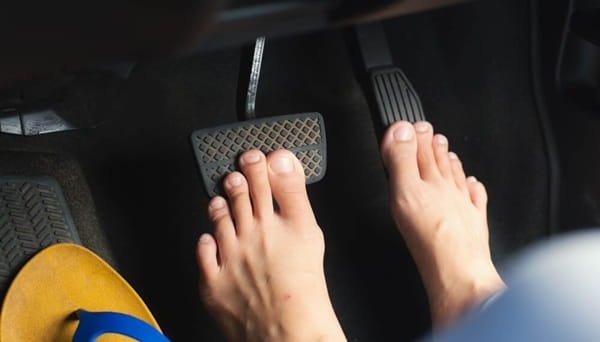
Driving barefoot is legal in Dallas, Texas. Neither Texas state traffic law nor Dallas municipal regulations impose a general requirement for drivers of ordinary passenger vehicles to wear shoes. You can legally operate a car without footwear, provided you maintain proper control and follow applicable traffic laws.
However, legal permission does not necessarily mean driving barefoot is the safest choice. Footwear can affect pedal control, and the circumstances surrounding an accident may raise questions about a driver’s ability to operate their vehicle safely.
Why Do People Think Driving Barefoot Is Illegal?
The misconception likely persists because many people associate footwear with safe vehicle operation.
Driving instructors often recommend secure, comfortable shoes, and some drivers assume those recommendations are legal requirements.
There is also confusion between different types of vehicles and driving situations. Workplace safety policies, commercial transportation requirements, and motorcycle equipment recommendations can differ from the rules governing ordinary passenger cars.
In Dallas, the relevant distinction is straightforward: a safety recommendation is not automatically a legal obligation.
Texas law does not require passenger vehicle drivers to wear sneakers, boots, sandals, or any other particular type of footwear.
What Texas Traffic Laws Actually Require
Although Texas does not prohibit barefoot driving, motorists must still operate their vehicles responsibly.
Several provisions of the Texas Transportation Code may become relevant when a driver’s actions create dangerous conditions.
Reckless Driving Under Section 545.401
Texas Transportation Code Section 545.401 prohibits driving with willful or wanton disregard for the safety of people or property.
Reckless driving is a misdemeanor punishable by a fine of up to $200, confinement in county jail for up to 30 days, or both.
Driving without shoes does not automatically satisfy this definition.
However, deliberately operating a vehicle in a dangerous manner could support a reckless driving charge regardless of whether the driver is barefoot.
Maintaining Control of the Vehicle
Drivers must comply with applicable traffic regulations, including speed limits, traffic signals, and rules governing safe vehicle operation.
If a driver’s foot slips from the brake pedal and causes a collision, investigators may examine whether the driver failed to exercise reasonable care.
The important issue would be the driver’s conduct and its consequences, not merely the absence of shoes.
Is Barefoot Driving Safer Than Wearing Flip-Flops?
Footwear choice can influence how effectively someone operates the accelerator and brake pedals.
Loose sandals and flip-flops may create particular problems because they can shift while driving or become trapped beneath a pedal.
Bare feet eliminate some of those risks, although they introduce different concerns.
Consider the following differences:
- Bare feet: May provide direct pedal contact but offer little protection from sharp objects or uncomfortable pedal surfaces.
- Flip-flops: Can slip off unexpectedly or interfere with pedal movement.
- High heels: May alter foot positioning and make consistent pedal pressure more difficult.
- Heavy boots: Thick soles can reduce pedal sensitivity.
- Secure athletic shoes: Generally provide stable contact, protection, and predictable pedal movement.
The safest option is footwear that allows the driver to operate every pedal smoothly without slipping or becoming trapped.
Can Dallas Police Pull You Over for Driving Barefoot?
An officer generally cannot justify a traffic stop solely because a driver is not wearing shoes, since barefoot driving itself is not prohibited.
However, police may stop a vehicle when they have reasonable suspicion of an actual traffic violation or another offense.
For example, an officer might observe a driver repeatedly drifting between lanes, failing to stop at traffic signals, or operating a vehicle dangerously.
Those actions may justify further investigation.
If the officer subsequently notices that the driver is barefoot, that observation does not independently establish a footwear-related offense.
A driver should not confuse an officer’s ability to investigate unsafe driving with a nonexistent general ban on driving without shoes.
Could Barefoot Driving Affect a Car Accident Claim?
This is where the legal discussion becomes more complicated.
Texas follows a modified comparative responsibility system for many personal injury claims.
Under Texas Civil Practice and Remedies Code Chapter 33, a person’s compensation may be reduced according to their percentage of responsibility. A claimant generally cannot recover damages if their percentage of responsibility exceeds 50%.
Barefoot driving alone does not establish negligence.
However, footwear could become relevant if evidence shows that it contributed to an accident.
For instance, if a driver suffered a foot injury from an object on the vehicle floor and consequently failed to brake, investigators might examine whether the driver’s conduct was unreasonable under the circumstances.
The absence of footwear would need a meaningful connection to the alleged negligence.
Practical Footwear Advice for Dallas Drivers
Dallas motorists frequently encounter heavy traffic, extended highway travel, and sudden braking situations.
Whether driving along Interstate 35E, navigating Central Expressway, or traveling through residential neighborhoods, reliable pedal control is essential.
Drivers can reduce unnecessary risks by following a few precautions:
- Keep the driver’s footwell free of loose objects.
- Avoid shoes that easily slide off while operating pedals.
- Choose footwear with secure soles and comfortable flexibility.
- Never place removed shoes where they could become trapped beneath the pedals.
- Make sure you can move between the accelerator and brake without difficulty.
- Pull over safely before adjusting footwear.
A spare pair of comfortable driving shoes can be useful for people who regularly wear heels, sandals, or other footwear unsuitable for driving.
Frequently Asked Questions
Q. Can you get a ticket for driving barefoot in Dallas?
No. Texas does not establish a general traffic offense for driving an ordinary passenger vehicle barefoot. However, motorists can still receive citations for unrelated traffic violations or unsafe driving conduct.
Q. Is driving barefoot legal on Texas highways?
Yes. The same general footwear rules apply when driving on Texas highways, including interstate routes passing through Dallas. Drivers must still comply with speed limits and other traffic safety requirements.
Q. Is driving in flip-flops illegal in Dallas?
No. Texas does not generally prohibit driving in flip-flops. Nevertheless, loose footwear can interfere with pedal operation, so secure shoes are usually a better safety choice.
Q. Can barefoot driving make you responsible for an accident?
Potentially, but not simply because you were barefoot. Liability depends on negligence, causation, and the circumstances of the collision. Evidence that footwear choices contributed to unsafe driving may become relevant.
Q. Does Texas require shoes during a driving test?
The general traffic law does not impose a footwear requirement for ordinary driving. However, applicants should follow the Texas Department of Public Safety’s current examination instructions and wear footwear that allows safe, reliable pedal control.